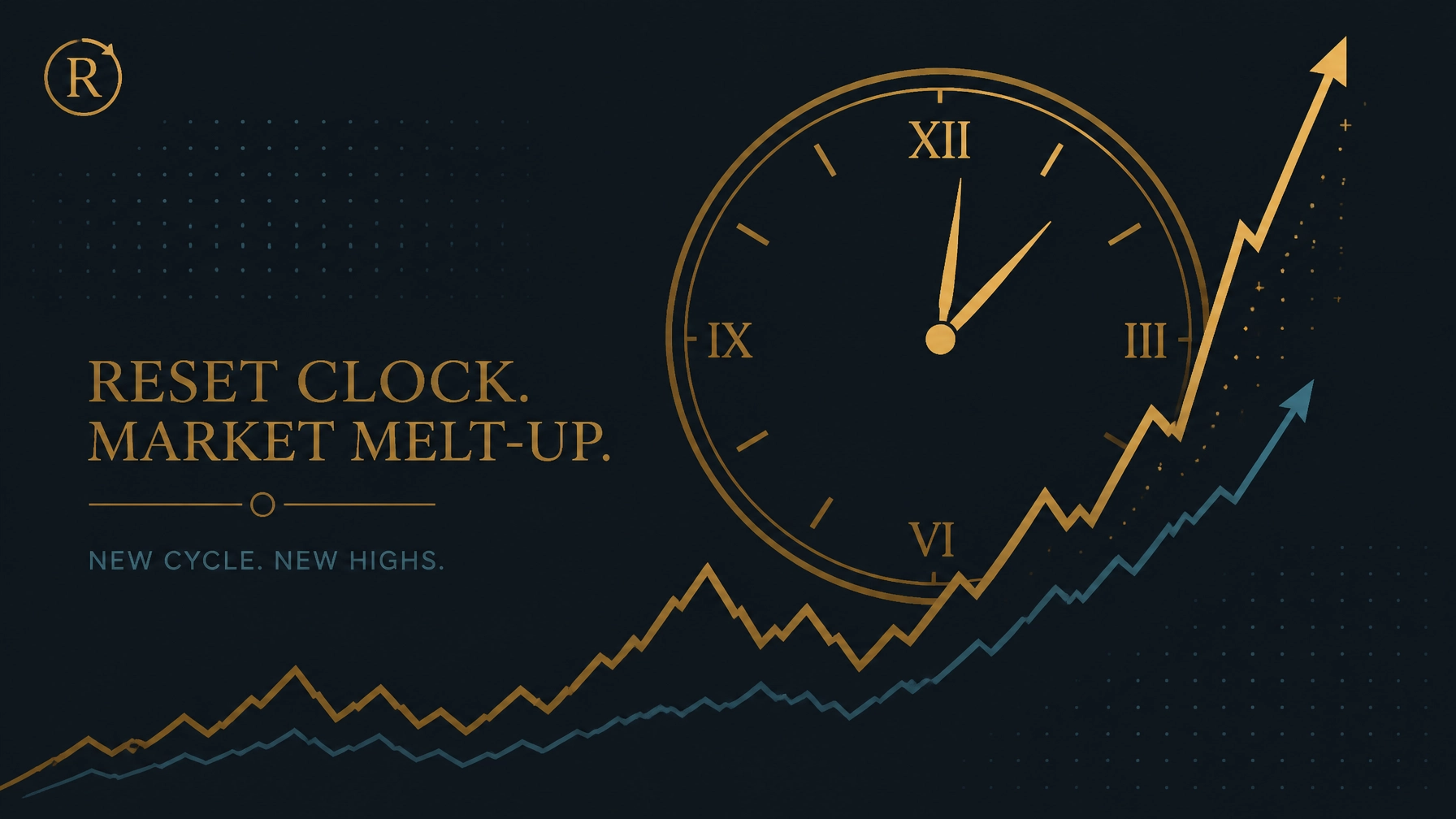
The Reset Clock : Chapter 5
There is a particular kind of quiet that settles over an economy when asset prices begin to detach from gravity. It does not sound like panic; it sounds like celebration. Cocktail party conversations turn effortlessly to compound interest, and acquaintances who previously couldn't distinguish a balance sheet from a balance beam suddenly speak with the unearned certitude of secular prophets.
We find ourselves in such a climate today. As we navigate the mid-2026 landscape, the S&P 500 trades at forward earnings multiples hovering near $21\times$, comfortably above historical norms [20], while the Buffett Indicator: total market capitalization relative to gross national product: sits near an elevated $227%$ [20]. Powered by an unprecedented wave of hyperscaler artificial intelligence capital expenditures [7] and a relentless semiconductor bid [12], global equities have surged through bouts of geopolitical friction and sticky inflation [5].
Yet, to mistake a melt-up for genuine economic health is to mistake the feverish flush of a patient for the glow of vitality. A market melt-up: a rapid, climactic upward sprint driven by momentum, fear of missing out (FOMO), and narrative rather than foundational cash flows [8, 10, 17]: is fundamentally more dangerous than a market crash. Crashes shock you into vigilance; melt-ups lull you into a stupor. While your portfolio ticker climbs day after day, a silent partner is at work: inflation.
1. The Anatomy of a Melt-Up: From 1929 to the 2026 AI Surge
Financial history is littered with the bones of momentum. A melt-up is the final, euphoric movement of a mature cycle: a vertical velocity where investors abandon prudence, willing to pay any price for distant, speculative earnings [2, 8, 15]. We saw it in the frantic final months of 1929 before the precipice; we watched it replay in the dizzying heights of the dot-com mania in 1999, where telecommunications and internet infrastructure stocks detached entirely from rational cash-flow generation.

Today’s 2026 environment shares those familiar DNA strands. Following sharp swings that saw broad indices recover aggressively from early-year jitters [6], the market has settled into a narrow leadership model [18]. Hyperscale data center investments and semiconductor innovations are driving corporate capital expenditure growth near $9%$ year-over-year [7]. Wall Street strategists openly debate whether we are marching toward a "1999-type melt-up" capable of pushing major benchmarks significantly higher before gravity reasserts itself [15].
As Peter Lynch famously observed, “Insiders might sell for any number of reasons, but they buy for only one: they think the price will rise.” In a melt-up, however, buying ceases to be an act of calculated ownership and becomes an act of tribal participation. You are no longer buying a business; you are buying a ticket to a rising river, ignoring whether the river is fed by underground springs or a temporary flash flood.
2. The Nominal Illusion and the Inflationary Phantom
To understand the peril of a melt-up, you must first separate nominal value from real value.
Imagine owning a home in a river valley where the water level is rising not because of nourishing spring rains, but because silt is choking the riverbed. Your property values on paper might look extraordinary as the floodwaters lap at your porch. You feel richer. Yet, every fundamental input required to sustain life: energy, labor, materials: is surging in cost.
This is precisely what occurs when sticky inflation collides with asset inflation. Headline inflation persists in the mid-single digits, driven by energy shocks and commodity pressures [5, 11]. Meanwhile, money supply growth and exogenous supply constraints continue to erode the purchasing power of each dollar [1]. When your portfolio grows by $8%$ in a year where real purchasing power declines by $5%$ due to persistent inflation and energy costs, you have not grown wealthy; you have merely treaded water while paying taxes on the illusion of progress.
Carl Jung once warned that until you make the unconscious conscious, it will direct your life and you will call it fate. The collective unconscious of a bull market is driven by an unexamined worship of nominal numbers. When you look at a $20%$ portfolio gain, your brain fires with the dopamine of validation. You fail to ask the harder, more rigorous question: What does this capital actually purchase today compared to three years ago?
3. The Wealth Effect Trap and the Hierarchy of Financial Needs
Economists speak reverently of the "wealth effect": the psychological phenomenon wherein consumers spend more freely as the paper value of their stocks and real estate appreciates. In a normal economic cycle, this grease keeps the wheels of commerce turning. But in a late-cycle melt-up, the wealth effect becomes a trapdoor.

When you feel wealthy because of transient asset appreciation, your consumption patterns shift before your foundational safety is secured. You commit to higher fixed overhead, larger discretionary expenditures, and relaxed cash buffers.
This violates the basic architecture of human well-being outlined in Maslow’s hierarchy of needs. Financial security is not located at the apex of speculative risk; it resides at the foundation. If your financial house is built upon sand: dependent entirely on continued multiple expansion in a handful of over-concentrated AI megacaps while the average S&P 500 member suffers deep under-the-surface drawdowns [18]: then your safety is illusory.
Epicurus taught that true wealth is not having great possessions, but having few wants and maintaining self-sufficiency. A market melt-up preys on the exact opposite impulse: it manufactures endless wants by convincing you that everyone else is getting rich effortlessly. It replaces prudence with gluttony: not just for food or drink, but for financial ego.
4. The Contrarian Discipline: Essentialism and Prudence
How do you inoculate yourself against the intoxicating contagion of a melt-up?
First, embrace the tenets of Essentialism, a discipline brilliantly articulated by Greg McKeown. Essentialism is the disciplined pursuit of less. In investing, this means ruthlessly cutting away the noise of fads, meme stocks, and speculative momentum. You do not need to own every asset class that is doubling in a given quarter. You need to own what protects your core capital and aligns with your measured risk tolerances.
Second, practice the ancient habit of paying yourself first: not into speculative equities, but into true liquidity and foundational reserves. Cash and cash equivalents are often mocked during a melt-up as a "drag on returns." But cash is the dry powder that grants you psychological sovereignty. As Harvey Munger understood through a lifetime of disciplined investing and patient frugality, the game is rarely won by the person who sprints the fastest in the final furlong; it is won by the person who has enough fuel remaining to walk calmly when the storm hits.

Veterans of market cycles note that late-stage melt-ups frequently precede sharp, painful corrections [10, 17]. Whether the catalyst is an escalation in energy shocks pushing crude oil past $100$ a barrel [5], sticky inflation forcing central banks to rethink policy assumptions [11], or a sudden reassessment of artificial intelligence capital expenditure returns [7], the transition from euphoria to gravity is notoriously abrupt.
Conclusion: Anchoring in Responsibility
When the river runs fast and the air is thick with the scent of easy gains, the most radical act you can commit is stillness.
Resist the siren song of the melt-up. Guard your portfolio not with greed or ego, but with the quiet virtues of responsibility, prudence, and structural discipline. A properly constructed financial life does not depend on catching the final, vertical spike of a speculative bubble. It relies on a sturdy foundation, rigorous risk management, and the serene knowledge that your wealth is built to weather any season: whether the market is celebrating at the summit or searching for footing in the valley below.
Sources & References
- Bureau of Economic Analysis & Federal Reserve Economic Data (FRED). Real GDP Growth and Money Supply Aggregates Report, Q1-Q2 2026. FRED Economic Data
- Shiller, Robert J. Irrational Exuberance, Princeton University Press. Historical valuation analysis of 1929, 1999, and modern equity cycles. Princeton University Press
- U.S. Bureau of Labor Statistics. Employment Situation Summary: Nonfarm Payrolls and Labor Market Tightness, 2026. BLS Data
- Morgan Stanley & Goldman Sachs Global Investment Research. Mid-Year 2026 Outlook: Navigating Late-Cycle AI Capex and Energy Shocks, June 2026. Goldman Sachs Insights
- Bank of America Global Research. Macro Strategy Warning: Sticky Inflation, Energy Prices, and Market Melt-Up Vulnerabilities, May 2026. BofA Global Research
- Buffett, Warren. Berkshire Hathaway Shareholder Letters and Market Valuation Metrics (The Buffett Indicator). Berkshire Hathaway
Disclaimer: Regatta Financial LLC is a fee-based registered investment advisor. This publication is provided for informational and educational purposes only and does not constitute professional financial, tax, or legal advice. Past performance is no guarantee of future results. All investments involve risk, including the possible loss of principal. Consult with a qualified professional regarding your specific financial situation before making any investment decisions.