
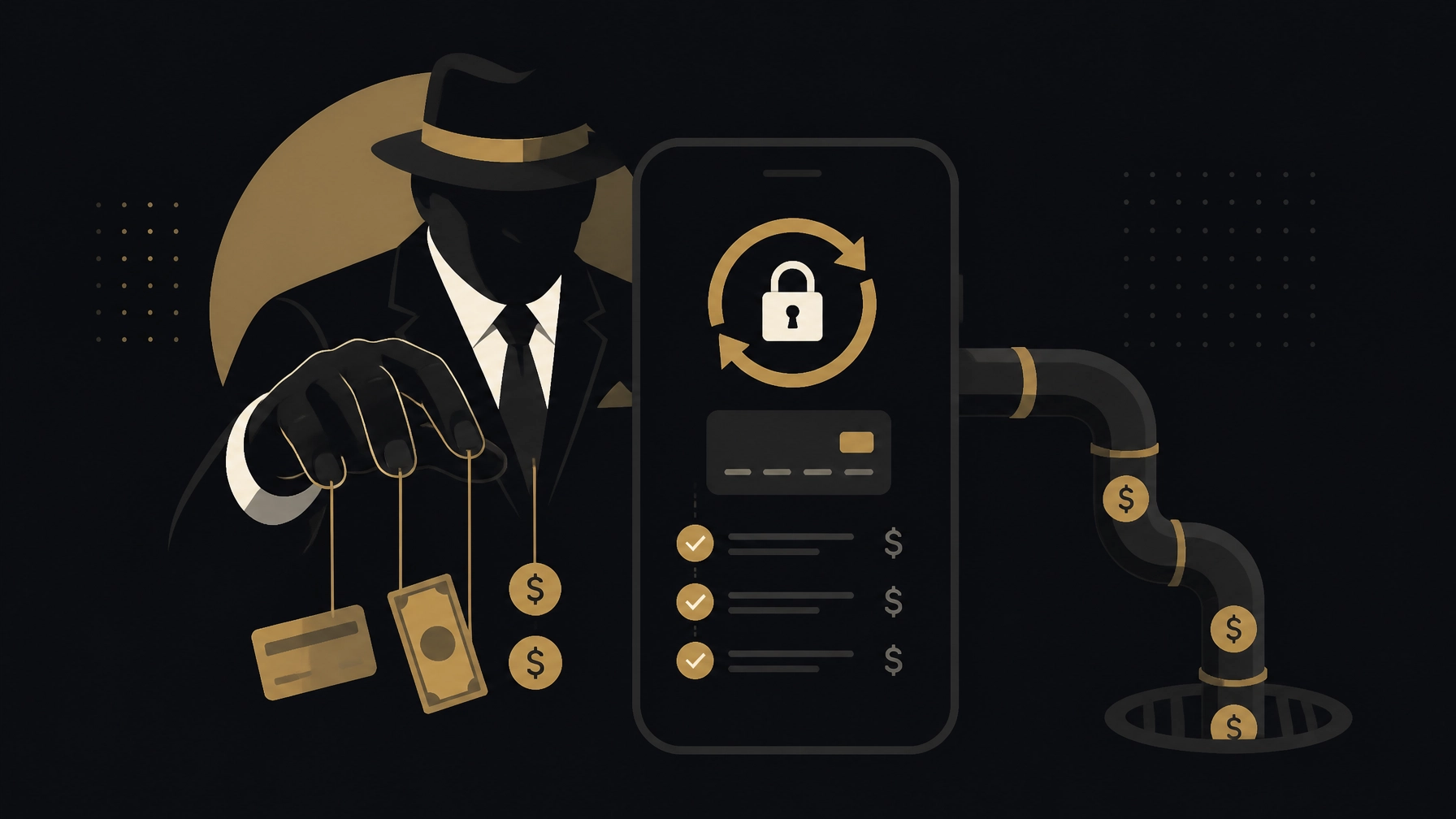
You sign up for a service in less than a minute. A few clicks, perhaps a promotional price, and the door opens.
Months later, you discover that the door out is somewhere else entirely. It may be hidden behind an account page, a chatbot, a phone queue, a retention pitch, or a form that asks you to explain why you no longer want what you already said you no longer want.
The charge is small enough to escape immediate notice. The service is quiet. Your attention is elsewhere. The subscription survives, not because you are actively choosing it, but because the system has learned how profitable your inattention can be.
This is the economics of auto-renewal: instant consent, delayed consequence, and cancellation by endurance.
The old neighborhood protection racket worked by exploiting a simple asymmetry. The shopkeeper bore the real risk. The collector controlled the choke point. Payment did not buy a new good so much as temporary relief from a problem the collector was often helping create. Modern subscription traps are cleaner, quieter, and dressed in product language, but the underlying economics can look uncomfortably familiar: a software gatekeeper extracts small recurring tolls, builds the exit behind procedural walls, and then treats your attempt to recover the money as a nuisance rather than a right.
Not every automatic renewal is unlawful. A subscription can be convenient, clearly disclosed, and easy to stop. But when a business obscures recurring charges, treats silence as consent, engineers friction into cancellation, and hides behind zero-refund walls after the charge hits, the practice begins to resemble a digital protection racket. Small businesses and households bear the disproportionate risk; the platform keeps the toll.
The Legal Fiction of Perpetual Consent
Federal regulators call these arrangements “negative options.” The term covers automatic renewals, continuity plans, and free-to-paid trials in which a consumer’s silence or failure to cancel is treated as acceptance of continued billing.1
The central problem is not that a customer once agreed to pay. The problem is that the original agreement is often treated as permanent, even when the customer has forgotten the service, stopped using it, missed a price change, or tried unsuccessfully to leave.
Consent is not a stone monument. It is more like a bridge: it needs to remain visible, intelligible, and usable. A buried disclosure at checkout cannot reasonably carry the weight of indefinite future charges.
The Federal Trade Commission has identified recurring failures in three areas: inadequate disclosure, billing without informed consent, and cancellation procedures that are difficult or impossible to use.2 The Consumer Financial Protection Bureau has similarly warned that dark patterns can steer consumers into subscriptions and obstruct their attempts to cancel.3
The legal question, then, is not simply whether a consumer clicked “accept.” It is whether the surrounding system made that acceptance informed, meaningful, and revocable.
The Forget-to-Cancel Business Model
The subscription economy is built on recurring revenue. That is not inherently sinister. Regular payments can help a business plan, and consumers may prefer uninterrupted access.
The trouble begins when the business model quietly depends on customers who do not use the service, do not notice the charge, or cannot complete the cancellation process.
A single forgotten subscription may cost $10 or $20. A large population of forgotten subscriptions becomes a river of predictable cash. The individual charge is easy to dismiss; the aggregate is difficult to ignore.
The FTC reported that it received nearly 70 consumer complaints per day about negative-option and recurring-subscription practices in 2024, up from 42 per day in 2021.4 In a 2026 rulemaking notice, the agency said the complaint rate had risen to more than 90 per day in 2025.5
Those figures are not a complete measure of consumer harm. Many people do not complain. Some do not recognize the merchant descriptor on a statement. Others conclude that recovering a modest amount would require more time than the money is worth.
That is precisely what makes the model powerful. The friction is distributed across millions of individuals, while the revenue is concentrated in the company’s accounts.
Like a classic street-level shakedown, the scheme does not require a dramatic payment from each target. It requires a wide base of people and smaller firms who decide that fighting is too time-consuming, too confusing, or too humiliating for the amount at stake. The toll is modest enough to feel survivable, but persistent enough to become lucrative when multiplied across a monopoly-scale customer base.

The business does not need every customer to remain enthusiastic. It needs enough customers to remain inert.
Dark Patterns and Engineered Friction
A dark pattern is not merely an unattractive website. It is a design choice that manipulates a user toward an outcome that benefits the company while conflicting with the user’s intention.3
The familiar examples are now almost mundane:
- A “Start free trial” button displayed prominently while recurring terms sit in faint text.
- A pre-checked box that adds a paid feature.
- A cancellation button hidden under “account settings.”
- A requirement to call during limited hours.
- A series of retention offers presented after the consumer has already selected cancel.
- A final confirmation screen that quietly re-enrolls the customer.
- A claim that cancellation is complete when billing continues.
The FTC’s 2021 policy statement says sellers should not impose unreasonable barriers or impede promised cancellation procedures. It specifically identifies hanging up on customers, placing them on unreasonably long holds, providing false cancellation information, and misrepresenting delays as problematic conduct.2
The difference between persuasion and obstruction is not complicated. A business may explain what a customer will lose by canceling. It should not make the customer earn the right to leave.

The FTC Rule That Was, and Is Not
In October 2024, the FTC adopted a broad “click-to-cancel” rule requiring sellers to make cancellation as easy as enrollment. The rule also addressed material disclosures, express informed consent, and immediate cessation of charges.4
But the legal story did not end there. In July 2025, the U.S. Court of Appeals for the Eighth Circuit vacated the amended rule on procedural grounds.5 The decision did not declare cancellation mazes acceptable. It removed that particular nationwide rule.
As of August 2026, the FTC’s existing Negative Option Rule has reverted to its older, narrow focus on prenotification plans such as product-of-the-month clubs. It does not comprehensively cover modern automatic renewals, continuity plans, or free-trial conversions.1
The FTC has restarted the process through an advance notice of proposed rulemaking. That proceeding seeks evidence on the size of the market, the cost of unused subscriptions, cancellation barriers, retention offers, and possible regulatory alternatives.6
For now, the legal framework remains a patchwork. Section 5 of the FTC Act prohibits unfair or deceptive practices. The Restore Online Shoppers’ Confidence Act governs important aspects of online negative-option transactions. The Telemarketing Sales Rule applies to telephone offers. The Electronic Fund Transfer Act addresses recurring debits from bank accounts.1
A customer should not need a law degree to cancel a streaming service. Yet the regulatory system often asks agencies to fit modern subscription machinery into statutes designed for older forms of commerce.
States Are Building the Exit
State legislatures have begun filling the gap.
New York law requires clear disclosure of renewal terms, affirmative consent, simple cancellation through the same medium used for consent, and restrictions on obstructing or delaying cancellation. It also provides notice requirements for certain long-term renewals, free trials, and material changes.7
Colorado’s 2025 law requires an online cancellation opportunity when a consumer consented online. It allows a company to present a retention offer only if it simultaneously displays a direct cancellation link.8
Maryland’s 2025 automatic-renewal law requires clear disclosures and a simple, cost-effective, widely available, timely, and easy-to-use method for canceling and stopping recurring charges.9
These laws differ in details, scope, exemptions, notice windows, and enforcement. That variation creates compliance work for businesses, but the underlying principle is consistent: the exit should not be harder to find than the entrance.
Banks and Card Networks Are Part of the System
The merchant is not the only actor involved. The bank, card issuer, payment processor, acquiring bank, and card network form the plumbing through which recurring charges travel.
Visa requires subscription merchants using free trials or introductory promotions to obtain express consent, provide confirmation of terms, send certain advance notices, and offer an easy online cancellation method.10 Mastercard has likewise established standards for subscription and recurring-payment merchants, including account-management and cancellation instructions in electronic communications.11
These network rules are not the same as federal law, and they do not guarantee an automatic refund. But they provide mechanisms for issuers to dispute charges where a customer canceled, never agreed to recurring billing, or was misled about the terms.
For credit-card billing errors, the Consumer Financial Protection Bureau advises consumers to notify the issuer promptly and send a written dispute within 60 days of the statement containing the error.12 For recurring debits from a bank account, federal rules require authorization, and consumers may revoke permission and request that their financial institution stop future transfers.13
In theory, this is a system of checks. In practice, consumers are often told to resolve the issue with the merchant, while the merchant points back to the bank. The money continues moving while the institutions debate whose problem it is.
That is not consumer protection. It is administrative ping-pong.
The Refund Mirage
The cruelest part of the auto-renewal machine often begins after the charge lands.
You notice the renewal quickly. You did not use the service. In some cases, no service was rendered at all beyond the bare fact that an account technically remained “available.” You contact support the same day, or within 24 hours. In ordinary life, that would seem to matter. If a contractor never arrives, you expect not to pay for the work. If a package never ships, you expect the charge to reverse. But much of the subscription economy now operates by a stranger logic: the instant the renewal posts, the vendor claims the month as earned.1415
This is where the protection-racket analogy stops sounding theatrical and starts sounding descriptive. In the historic neighborhood shakedown, the store owner was told to keep paying because the arrangement already existed and because resistance would cost more than obedience. In the digital version, the household or small business is told that the renewal already processed, the month is already owed, and the system cannot or will not unwind what the system just did. The threat is not a broken window. It is a walled-off refund channel, a support maze, and the certainty that contesting a small charge will consume more energy than the merchant spent taking it.
This is where the legal architecture becomes revealing. Many major subscription terms do not promise refunds as a right. They reserve them as a favor. The New York Times states that refunds or credits are issued at its “sole discretion.”14 Dow Jones, in the Wall Street Journal’s customer terms, says most fees are non-refundable, though refunds or credits may be granted at its “sole discretion.”15 USA TODAY likewise says it does not provide credits, refunds, or prorated billing for canceled subscriptions, while preserving the option to issue them at its sole discretion.16 The phrase is bloodless corporate prose, but its meaning is plain: you are not appealing to a rule; you are appealing to mercy.
That discretion becomes harder-edged in practice because many merchants pair it with blanket no-refund policies even where the customer says the service was never used, never wanted, or was canceled before but charged anyway.1617 The asymmetry is almost comical in its brazenness. If you cancel after the renewal, the merchant says the charge already processed and cannot be reversed. If you canceled before the renewal but the charge hits anyway, the merchant may still say the system shows an active renewal and therefore the charge stands.1718 You are left in the position of having either acted too late or, somehow, too early.
The law largely fails on a second, subtler point: the difference between canceling a subscription and recovering what was already prepaid for a term you will never use. Many annual or multi-year plans—streaming services, email and hosting accounts, even insurance-style renewals stretching into 2027 or 2028—treat cancellation as nothing more than shutting off the next automatic renewal while preserving your “access” until the paid term lapses.141516 But if you have explicitly canceled, sworn off the service, and will never log in again, that access is a legal fiction. The vendor is simply holding the prepaid balance as hostage capital for service that will never be delivered.
Economically, the arrangement is hard to defend. The company books the cash up front, keeps the float, and offers no proration back to the customer, even though many of the same vendors also offer monthly billing as a periodic option.1416 That detail matters. It shows the annual prepayment is not some sacred, indivisible obligation. It is a financing preference that benefits the company’s cash flow. The discount exists because the customer advances the money. Once the customer affirmatively abandons the service, retaining the entire unearned balance starts to look less like contract enforcement and more like a windfall.
Even when a vendor does relent and issue a partial refund or proration, it may deduct payment-processing or merchant fees from the returned amount, quietly passing the cost of its own payment plumbing back to the very customer it just alienated. This is where regulators and litigators have been slowest. Disclosure and cancellation-ease rules govern how a service is wound down, but almost no statute squarely addresses the retention of a prepaid balance for a term the customer has affirmatively abandoned.12 If annual plans are priced as a discount on lock-in, the law should treat a terminated prepaid term as what it economically is: an unearned advance that must be returned or prorated, not a windfall the vendor may hoard until the calendar catches up. That is one of the clearest holes in the current patchwork, and it is precisely where enforcement and statutory drafting are overdue.
One anonymized case captures the logic with unusual clarity. A small-business owner had paid in advance, through a future date, for several professional email mailboxes assigned to former employees. After realizing that multiple mailboxes were sitting unused, the owner asked the web-hosting provider whether the prepaid value could be refunded or, failing that, applied as a credit against the active mailboxes still being billed. The owner also asked to downgrade the plans to the standard tier. The provider refused any refund for the prepaid inactive accounts and offered no offsetting credit on the live bill, even though the unused mailboxes represented services that would never be rendered. Its only concession was a $52.99 refund for one mailbox that had never been configured at all—effectively the one reversal that cost the vendor almost nothing.21
The economics are the story. The owner had paid well over $200 in advance for nothing that would ever be delivered, then was told that the money would remain with the vendor anyway.21 When the owner pointed out that the charges had been paid before the renewal date and argued that a refund or credit was owed, the provider did not budge.21 The empty mailboxes became pure prepaid revenue harvested without any corresponding obligation to perform. That is the heart of the protection-racket dynamic in software form: money collected up front, remitted without service, and cemented by a refund policy that treats even clearly unused services as non-refundable.
For a large software platform, one extra month’s fee is nearly frictionless revenue. For a household balancing bills or a small business juggling payroll, ad spend, software licenses, and merchant fees, that same “minor” charge is another toll extracted from a foundation already carrying too much weight. This is how disproportionate risk works in practice: the monopolistic vendor industrializes collection, while the smaller actor internalizes the hassle, the lost time, and the cash-flow hit.
The time-value advantage to the vendor is obvious. Keeping even one extra month’s fee across a large subscriber base is not trivial; it is the point. The company holds the cash now, earns float on it now, books the revenue now, and forces you to spend time, paperwork, and attention to get back what should not have left your account in the first place.45 In river terms, the current runs downhill toward the merchant. To reverse it, you must row upstream with screenshots.
When support channels fail, chargebacks and card-network disputes become the customer’s only real leverage.1213 Yet even here the process is often delayed, narrowed, or quietly discouraged. The FTC’s consumer guidance tells people to dispute charges if they were billed without consent or after canceling, which is another way of admitting that the merchant-side refund path is often not dependable.19 Consumer reporting has documented the same pattern: banks may help, but consumers are frequently pushed back to the merchant first, and refunds for unused or auto-renewed services are often hidden behind opaque terms and persistence tests masquerading as policy.20
This is the gaslighting layer of the system. The merchant says the renewal was valid because you did not cancel correctly, or because you canceled too close to the billing date, or because continued access counts as service delivery even if nothing was used.18 The bank says the merchant must first deny relief before a dispute can fully proceed.12 Everyone acknowledges friction; no one owns it.
At some point, the euphemisms collapse. A legitimate subscription is a consensual exchange. If the charge renews after consent has effectively ended, and the refund path is functionally nonexistent even when you object immediately and receive nothing of value, the transaction stops looking like a contract and starts looking like involuntary extraction. Polite language cannot improve the ethics of that conversion. When a company keeps money for a renewal you tried to stop, refuses to unwind it on the theory that its own terms grant it sole discretion, and leaves chargeback warfare as your only recourse, it has crossed the line from convenience into a species of corporate extortion—an automated tollbooth built by firms large enough to make your objection feel uneconomic.23
What Lawmakers Should Do
Congress and state legislatures should establish a few durable rules.
First, require separate, affirmative consent to recurring billing. The subscription term should not be buried inside general terms or inferred from a pre-checked box.
Second, require cancellation to be at least as easy as enrollment. If a consumer can enroll online in three clicks, the consumer should be able to cancel online in three clicks, without a mandatory phone call or retention interrogation.
Third, require usable reminders. Before a free trial becomes paid, a promotional rate expires, or a long-term subscription renews, the notice should state the amount, date, and direct cancellation path.
Fourth, prohibit post-cancellation billing. Once a consumer has canceled through a legally compliant channel, continued charges should be presumptively unauthorized unless the company can demonstrate a clear technical or factual error and promptly correct it.
Fifth, make payment intermediaries accountable. Banks, processors, and card networks should maintain practical merchant-level stop mechanisms and investigate patterns of repeated post-cancellation charges rather than treating each customer as an isolated dispute.
Sixth, require records. A company that charges a consumer repeatedly should be able to produce the consent record, the material terms presented, the renewal notices sent, and the cancellation history.

The goal is not to eliminate subscriptions. It is to eliminate the business advantage created by confusion.
Your financial life already contains enough invisible currents: fees, interest, inflation, taxes, and market risk. A recurring charge should not become permanent merely because it is small enough to hide.
The essential habit is simple: pay yourself first, know where your money flows, and periodically inspect the channels. But personal prudence cannot substitute for public rules. A system that profits from forgetfulness will always outspend the individual’s attention.
Responsibility belongs to consumers. It also belongs to the companies, banks, networks, and lawmakers that decide how difficult it should be to say no.
Sources
- Federal Trade Commission, Advance Notice of Proposed Rulemaking on Negative Options, Federal Register, 2026
- Federal Trade Commission, Enforcement Policy Statement Regarding Negative Option Marketing
- Consumer Financial Protection Bureau, Circular 2023-01: Unlawful Negative Option Marketing Practices
- Federal Trade Commission, Final “Click-to-Cancel” Rule Announcement, October 16, 2024
- Federal Trade Commission, 2026 Negative Option Rulemaking Notice
- Federal Trade Commission, Request for Public Comment on Negative Option Regulations, March 24, 2026
- New York Senate, General Business Law § 527-a
- Colorado General Assembly, SB25-145: Online Cancellation of Automatic Renewal Contracts
- Maryland General Assembly, Chapter 205, House Bill 107: Consumer Protection: Automatic Renewals
- Visa, Updated Policy for Subscription Merchants Offering Free Trials or Introductory Promotions
- Mastercard, Revised Standards for Subscription/Recurring Payments and Negative Option Billing Merchants
- Consumer Financial Protection Bureau, How to Dispute a Charge on Your Credit Card Bill
- Consumer Financial Protection Bureau, Consumer Authorization for Recurring Auto-Debits
- The New York Times, Terms of Sale
- Dow Jones / Wall Street Journal, Customer Center Terms of Use
- USA TODAY, Subscription Terms
- Better Business Bureau, Daily Wire Business Profile
- Federal Trade Commission, First Amended Complaint in FTC v. Uber Technologies, Inc., et al.
- Federal Trade Commission, Getting In and Out of Free Trials, Auto-Renewals, and Negative Option Subscriptions
- The Guardian, “I was flabbergasted”: refunds for unused subscriptions may be easier than you think
- Author's case notes: documented interaction between a small-business owner and a web-hosting provider regarding prepaid email mailbox refund denial, on file with the author.
About the Author
Regatta Financial LLC is a fee-only wealth management firm based in Gaithersburg, Maryland. This commentary is published for policy discussion and educational purposes. It is not investment, legal, tax, or accounting advice, and it is not intended as an advertisement of advisory services.