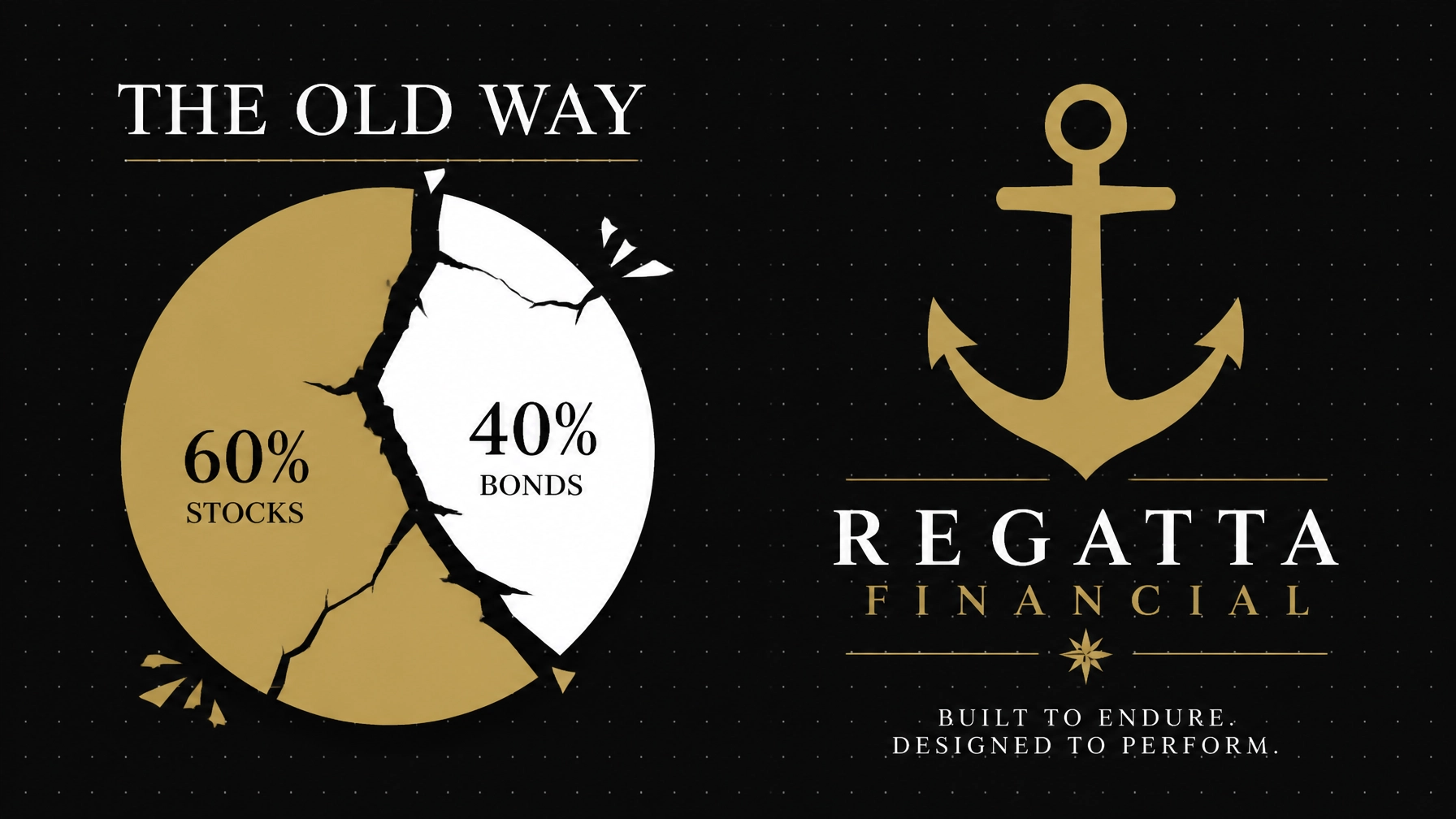
For decades, the 60/40 portfolio was the "Easy Button" for retirement. Put 60% of your money in stocks, 40% in bonds, and go play golf. It was built on a simple premise: when stocks go down, bonds go up.
That old model still haunts a lot of portfolios like a ghost rattling chains in the attic. It looks familiar. It sounds comforting. It is also dead weight if you mistake yesterday’s conditions for today’s reality.
In 2026, that premise is dead.
We are living through a period of persistent volatility where the old rules don't apply. Inflation and interest rate swings have forced stocks and bonds to move in lockstep. When they both fall at the same time, your "diversified" portfolio isn't a safety net: it’s an anchor dragging you down.
It’s time to stop coasting on 20th-century ideas. You need a wealth management strategy built for the reality of today, not the nostalgia of yesterday.
Chapter 1: The 60/40 Fossil
The traditional model worked beautifully when interest rates were falling and inflation was dormant. That world is gone. Today, the correlation between stocks and bonds has spiked. This means that during market stress, your bond "ballast" often disappears exactly when you need it most.
Relying on a 60/40 split is a form of lazy diversification. It’s the "Joneses" approach to investing: doing what everyone else does because it’s comfortable. But as we’ve discussed in The Myth of the Joneses, following a sinking ship just because it’s a popular one won’t save your retirement.
At Regatta Financial, we don’t believe in "set it and forget it." We believe in proactive risk management. We don’t just look at asset classes; we look at risk models.
Chapter 2: The River of Volatility
The market is not a machine. It is a river. Sometimes it runs steady. Sometimes it floods. Sometimes it changes course and drags unprepared people downstream.
That is the problem with lazy retirement planning. You assume the current is calm because it was calm for a while. Then the river rises, correlations shift, and the nice tidy labels in your portfolio stop protecting you.
Carl Jung put it plainly: "Until you make the unconscious conscious, it will direct your life and you will call it fate."
That applies to investing more than most people want to admit. If you do not identify the hidden assumptions in your portfolio, those assumptions will control your outcome. You will call it bad luck. It is usually unmanaged risk.
Your job is not to predict every bend in the river. Your job is to build the banks. Set risk limits. Know what each asset is supposed to do. Cut what no longer serves the mission. Stop confusing motion with progress.
That is how you stay afloat when the current turns ugly.
Chapter 3: The 5,000-Year Audit
Investors often have a short memory. They think the "market" began in 1920. But if you want to protect your family’s legacy, you need to look at the 5,000-year audit.

Stocks and bonds, in their modern form, are only a few hundred years old. They are paper promises backed by institutions that, in the grand scheme of history, are still in their infancy.
Gold, silver, and farmland have been stores of value for millennia. They have survived currency collapses, world wars, and the rise and fall of empires. While the 60/40 model struggles with modern inflation, these "primitive" assets offer a track record that paper simply cannot match.
Prudence demands that you acknowledge this history. If you are building a Financial Fortress, your foundation shouldn't just be built on the trends of the last 50 years. It should be built on the proven stability of the last 5,000.
Chapter 4: Essentialism in Investing
In his book Essentialism, Greg McKeown argues for the "disciplined pursuit of less." This isn't just about cleaning out your closet; it’s a philosophy for your balance sheet.
Most investors have a "Gluttony" problem. They collect mutual funds, ETFs, and "hot" stock tips like they’re gathering junk in an attic. They have 20 different accounts but no actual plan. This complexity creates the illusion of safety while hiding massive risks.
Stop the clutter. Do this instead:
- Identify your essential goals. What is the money actually for?
- Cut the noise. If an investment doesn't fit your specific risk model, dump it.
- Focus on "Less but Better." Instead of a thousand mediocre positions, hold a concentrated strategy that you actually understand.
Harvey Munger famously said, "The big money is not in the buying and the selling, but in the waiting." He also taught the idea of the Lollapalooza effect: when multiple forces pile up in the same direction, the outcome gets extreme fast. That works in markets too. Greed, leverage, crowd behavior, and lazy diversification can all stack on top of each other and produce one ugly result.
McKeown followed up Essentialism with a book called Effortless — because cutting the non-essential is only half the battle. You also need to make the essential things easier to do. A good portfolio should not require constant attention to stay on course.
So cut complexity before complexity cuts you. By stripping away the non-essential, you gain the clarity needed to stay the course.

Chapter 5: The Regatta Seven
We don't fit you into a pre-made 60/40 box. At Regatta Financial, we manage seven distinct portfolios. Each one is a building block designed to handle specific market conditions and risk profiles.
When you work with us, you don't just get a "moderate" or "aggressive" label. You get a customized allocation across these seven portfolios based on your proportional risk metrics.
- Cash Management: Your immediate liquidity. The oxygen of your plan.
- Fixed Income: Not just "bonds," but strategic protection against rate shocks.
- Conservative Growth: Stability with a slight edge.
- Core Equity: The engine of your long-term wealth.
- Aggressive Growth: For the capital you can afford to put to work.
- Alternative Risk: Strategies designed to zig when the market zags.
- Legacy Assets: Wealth meant for the next generation.
By segregating assets this way, we ensure that a dip in the stock market doesn't compromise your ability to pay your bills next month. This is Essentialism applied to finance: Focus on what matters, and ignore the noise.
We are a fee-only company. We don't charge commissions. We don't sell products. This means our only priority is your success. If we recommend a move, it’s because it’s right for your risk model, not because it earns us a kickback.
Our approach separates emotion from risk. As we move from Wall Street to Main Street, our goal is to help you navigate the "emotional volatility" that causes most investors to bail at the worst possible time. We use behavioral finance principles to ensure your portfolio is stress-tested for the real world, not just a spreadsheet.
Chapter 6: Mindset and Discipline
Peter Lynch once said, "The most important organ in the body as far as the stock market is concerned is the stomach, not the brain." He also said, "The real key to making money in stocks is not to get scared out of them."
That is not just a market lesson. It is a human lesson.
Maslow’s hierarchy is useful here. Start at the bottom. Physiological needs and safety come first. If your finances are fragile, you will not think clearly about long-term investing. You will react. You will flinch. You will sell at the worst time because your foundation is weak.
Build upward from there. Create stability. Protect cash flow. Reduce unnecessary debt. Establish margin. Then you can move toward confidence, purpose, and eventually something closer to financial self-actualization, where your money serves your values instead of your anxieties.
Epicurus said, "The man who is not content with little is content with nothing."
Read that twice. If your appetite has no brakes, no portfolio will ever feel big enough. The market will always find a new toy to tempt you. That is how greed gets dressed up as ambition.
In 2026, your stomach will be tested. The headlines will be loud, the "experts" will contradict each other, and the short-term fads (like the latest AI-driven crypto-meme-coin) will tempt your ego.
Guard yourself against these traps:
- Greed: Chasing returns in a high-risk environment is a recipe for disaster.
- Ego: Thinking you can outsmart the market without a risk model is pure folly.
- Fear: Panic is the most expensive emotion in the world.
Instead, practice Responsibility and Prudence. Understand that wealth is a river: it needs to flow, but it also needs banks to keep it from destroying everything in its path. Those banks are your risk management strategy.
Chapter 7: Action Plan
The 60/40 model is a relic. If you’re still using it, you’re flying a plane with 1940s instruments in a 2026 storm.

Here is your immediate checklist:
- Stress-test your current holdings. How did your "ballast" perform the last time stocks dipped? If your bonds fell too, you are over-exposed. Check out our guide on Stress Testing Your Portfolio.
- Audit for "Paper-Only" Risk. Do you have tangible stores of value, or is your entire legacy dependent on the stability of the modern banking system?
- Consolidate to Essentialism. Close the small, meaningless accounts. Simplify your life.
- Adopt a Risk-Model approach. Stop asking "What's the return?" and start asking "What's the risk?"
Your wealth is more than just a number on a screen: it’s your freedom, your family's security, and your legacy. Don't let an outdated model put it all at risk.
Ready to upgrade your strategy? Let’s chart a course that actually accounts for the world we live in today.
General Disclosure: Regatta Financial LLC is a registered investment adviser. This content is for informational and educational purposes only and does not constitute investment, legal, or tax advice. Past performance is not a guarantee of future results. All investment strategies and investments involve risk of loss, including the potential loss of principal. Any references to hypothetical scenarios or market projections are for illustrative purposes only and should not be relied upon as predictions of actual future performance. You should consult with a qualified professional for advice tailored to your specific financial situation. Advisory services are offered through Regatta Financial LLC.